Your DNA, decoded on your own machine.
gnomancer turns the raw file you already downloaded from AncestryDNA, 23andMe, MyHeritage, FamilyTreeDNA or LivingDNA into one readable report: lineages, traits, carrier status, drug metabolism, and a plain-language summary. Open source. Runs locally. Nothing is uploaded.
# macOS / Linux (Windows via WSL): one line to install, one to run
$ curl -fsSL https://gnomancer.com/install.sh | bash      # or: pipx install gnomancer && gnomancer setup
$ gnomancer ~/Downloads/AncestryDNA.zip
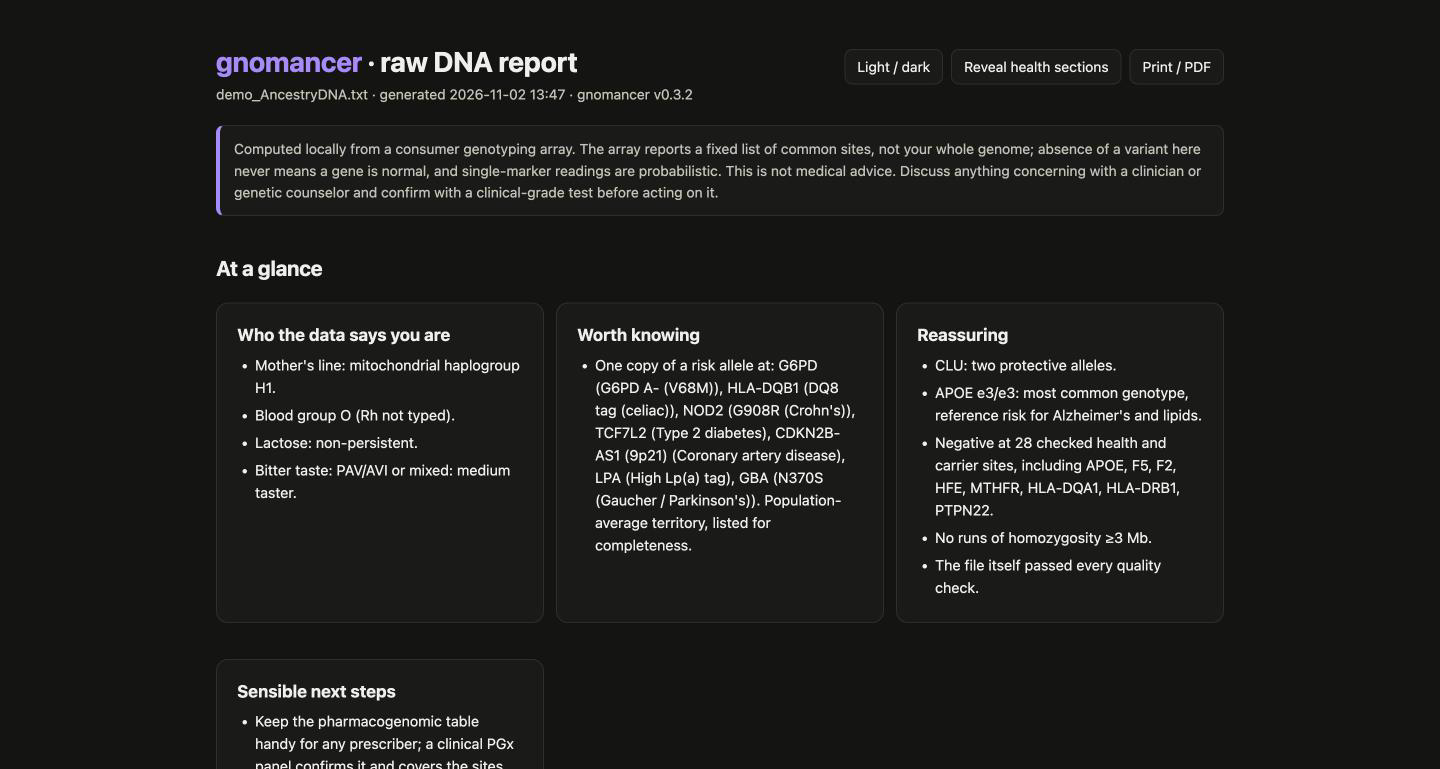
The report, generated from a synthetic demo file. Real reports open with an at-a-glance digest and an optional narrative written by your own AI assistant.
What you get
One self-contained HTML report (plus Markdown, TSV and JSON), built from the tools researchers actually use.
Lineages
Y haplogroup from yhaplo with a second opinion from Yleaf on current YFull, FTDNA and ISOGG trees; mitochondrial haplogroup from Haplogrep3. Each comes with population context.
Traits and ancestry markers
A curated panel of about 110 well-replicated sites: eye and hair pigmentation, lactase persistence, caffeine and alcohol metabolism, bitter taste, blood group, and more.
Health and carrier sites
APOE, Factor V Leiden, hemochromatosis, celiac HLA tags, macular degeneration, type 2 diabetes and the rare pathogenic sites that happen to be on consumer chips. Collapsed by default, for people who would rather not look.
ClinVar scan
Every typed site checked against ClinVar. Each hit is scored for plausibility, because arrays are unreliable at rare sites and a homozygous rare "pathogenic" call is usually an artifact.
Pharmacogenomics
PharmCAT star-allele diplotypes and CPIC phenotypes for 18 genes, with the drugs each one matters for and an honest per-gene coverage figure.
Plain language, and your own AI
An automatic at-a-glance digest, plus a narrative written by whichever AI assistant you already use. gnomancer is an MCP server too: connect it to Claude Desktop, Claude Code or Cursor and just ask "what does my report say about caffeine?" The file still never leaves your machine.
How it works
Three steps, all on your computer.
Download your raw data
Every major vendor lets you export it from your account settings. Step-by-step for each company. gnomancer reads the zip directly and detects the vendor and genome build.
Run one command
The installer sets up the open-source tools and public reference files once. Then gnomancer yourfile.zip does everything else in about a minute.
Read the report
Open REPORT.html. Light and dark, printable, searchable, with the technical detail one scroll below the summary.
Reads AncestryDNA23andMeMyHeritageFamilyTreeDNALivingDNAGenes for GoodtellmeGenVCF and remaps older builds to GRCh37.
Privacy, stated plainly
Your genotype file never leaves your computer. There is no account, no upload, no telemetry.
- The only network traffic is the one-time download of public tools and reference data (yhaplo, Haplogrep3, PharmCAT, ClinVar, the rCRS mitochondrial sequence).
- The optional
--aisummary sends the structured result tables, never the raw file, to the Anthropic API, and only when you ask for it. - This website is static. It sets no cookies and runs no analytics.
Under the hood
gnomancer is glue around tools that have been validated by the people who built them. Every one is open source.
| Tool | Contributes | Source |
|---|---|---|
| snps | vendor detection, normalization, build remapping | apriha/snps |
| yhaplo | Y haplogroup | 23andMe/yhaplo |
| Yleaf | Y haplogroup on current trees | genid/Yleaf |
| Haplogrep3 + PhyloTree | mitochondrial haplogroup | genepi/haplogrep3 |
| ClinVar | clinically classified variants | NCBI |
| PharmCAT | CPIC / PharmGKB star-allele calling | PharmGKB/PharmCAT |
| ezancestry | 1000 Genomes population estimate | arvkevi/ezancestry |